Biggest Tuf Gaming Vg259Qm Buying Mistakes (And How to Avoid Them)
Introduction
The ASUS TUF Gaming VG259QM has earned attention from competitive gamers and performance-minded buyers for its high refresh rate, fast response times, and gamer-focused feature set. Yet, enthusiasm alone can lead to buying mistakes: buyers often expect desktop-monitor behavior to mirror marketing copy without checking compatibility, use cases, or trade-offs. This article dissects the most common mistakes people make when considering the VG259QM and provides practical guidance to avoid buyer's regret. The goal is to help a prospective buyer decide with clarity whether this monitor fits their needs and budget, and how to set expectations correctly for real-world performance.
Detailed Product Review and Analysis
What the VG259QM is aiming for
The VG259QM is positioned as a fast, compact gaming monitor optimized for esports and fast-action titles. It emphasizes refresh rate and low latency over large panel size or broad color gamut. These design choices make it attractive for players who chase the smoothest motion and lowest input lag rather than color-critical creative work or cinematic HDR experiences.
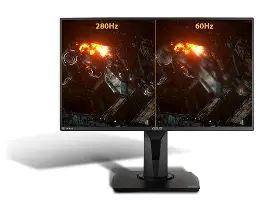
Performance: refresh rate, response, and motion handling
At the core of the VG259QM's appeal is raw speed: an extremely high refresh rate paired with a fast pixel response time. In practical terms this produces smoother frame-to-frame motion and reduced motion blur in fast-paced shooters, racing sims, and twitch-sensitive genres. The monitor also includes adaptive synchronization features to minimize tearing and stutter when frame rates vary. For most buyers, the crucial caveat is that the computer's GPU and the video connection must be capable of delivering the high frame rates that make the display worthwhile.
Design and build quality
The VG259QM typically comes with a compact 24–25 inch panel on an adjustable stand that allows height, tilt, swivel, and sometimes pivot. The casing is utilitarian and oriented toward gaming aesthetics without being fragile. VESA mounting is usually supported for buyers who prefer third-party arms. Buyers should check the physical dimensions and stand footprint before committing — a powerful monitor still matters less if it clashes with a cramped desk setup.
Connectivity and ergonomics
Modern high-refresh monitors rely on certain ports to unlock peak performance. DisplayPort support is commonly necessary to achieve the highest refresh rates at native resolution, while HDMI ports often cap out lower depending on generation. The VG259QM includes standard connectors expected in its class, but buyers must match cable versions and GPU outputs to avoid being limited to lower refresh rates. The monitor's on-screen display and joystick control are aimed at quick adjustments during gameplay; familiarity with the menu is useful because some features interact (for example, motion blur reduction and adaptive sync).
Color, calibration, and HDR
The VG259QM emphasizes speed over wide color gamut or deep HDR. Colors are generally punchy out of the box and acceptable for casual photo or video editing, but it is not a professional color-critical monitor. HDR support in monitors of this category tends to be limited — it can accept HDR signals and apply tone mapping, but it will not achieve the brightness and local dimming that make HDR "pop" on premium displays. Buyers who need accurate color reproduction or meaningful HDR performance should consider additional calibration tools or a different class of monitor.
Gaming features and software
Features such as variable overdrive, ELMB (motion blur reduction) or similar backlight strobing options, and adaptive sync compatibility are useful in different scenarios. ELMB can dramatically reduce perceived blur but may interact with adaptive sync in ways that require enabling a combined mode intentionally. On-board presets, crosshair overlays, and low-blue-light modes are small but practical inclusions. Buyers should be ready to experiment with overdrive and strobing settings — misconfigured options can introduce motion artifacts or inverse ghosting.
Find top-rated Electronics products at great prices.
Browse Now →Real-world use cases
For competitive FPS players, the VG259QM's high refresh rate and fast pixel response are tangible advantages: tighter aim tracking, smoother visuals, and lower perceived latency. For streamers and multitaskers, the smaller pixel density at 1080p on a 24–25 inch screen can make window management practical while keeping GPU load light. For creative professionals, the monitor may serve as a secondary workspace but not as a primary color reference. Console gamers must check console compatibility; many current-generation consoles cannot reach the highest PC-focused refresh rates and will behave like a conventional 60–120Hz display unless the console and cables explicitly support higher modes.
Pros & Cons
- Pros
- Exceptional refresh rate for ultra-smooth motion in competitive gaming
- Very low pixel response time and input latency for twitch gameplay
- Compact size suits multi-monitor desk setups and small desks
- Adaptive sync options reduce tearing and stutter across varied frame rates
- Ergonomic stand and VESA support allow flexible desk positioning
- Cons
- Not ideal as a primary display for color-critical photo/video editing
- HDR capability is limited compared with higher-end HDR panels
- High refresh rate benefits require a capable GPU and correct cables
- Some advanced modes (strobing/overdrive) need careful tuning to avoid artifacts
- Smaller size and 1080p resolution may feel cramped for productivity users who prefer more screen real estate
Comparison Table
| Model | Panel Size & Type | Native Resolution | Refresh Rate | Best For |
|---|---|---|---|---|
| ASUS TUF VG259QM | 24–25" Fast IPS | 1920 × 1080 | Very high (esports-oriented) | Competitive FPS, fast-action gaming, low-latency setups |
| ASUS VG259Q | 24–25" IPS | 1920 × 1080 | High (good for casual and competitive play) | Balanced gaming and everyday use with slightly fewer specialist features |
| 27" 1440p 144Hz IPS (General competitor) | 27" IPS | 2560 × 1440 | 144Hz | Higher resolution for content work and immersive gaming; heavier GPU load |
Common Buying Mistakes and How to Avoid Them
Mistake 1 — Assuming marketing numbers equal real-world experience
High refresh rates, low response times, and gaming modes can sound impressive. However, an advertised refresh rate is only as useful as the system that drives it. Buyers often assume "more hertz is always better," but without a GPU capable of sustaining high frame rates, the perceived benefit shrinks. The right approach is to assess the PC or console first and decide if the monitor's top-end capabilities are realistically usable.
Mistake 2 — Not matching cables and ports
Many buyers plug an HDMI cable into the GPU and wonder why the refresh rate is limited. DisplayPort and specific HDMI generations are required for the highest refresh modes at native resolution. To avoid this mistake, verify which port on the GPU supports the highest refresh rate and use a certified cable (or the cable provided) that matches the port's generation.
Mistake 3 — Expecting true HDR from a fast esports display
HDR performance requires high peak brightness, local dimming, and wide color volume. The VG259QM and similar fast panels typically support HDR signaling for games and video but cannot match the contrast and brightness of premium HDR monitors or TVs. Buyers who prioritize dramatic HDR should look at displays with higher HDR certifications and not equate "supports HDR" with "impressive HDR."
Mistake 4 — Ignoring ergonomics and desk fit
A compact, fast panel can still fail the setup test if the stand hits a shelf or the desk lacks depth. Check stand adjustments and VESA compatibility in advance. If a custom mounting arm or more screen real estate is needed, factor those costs and spatial requirements into the decision.
Mistake 5 — Overlooking firmware, drivers, and OSD quirks
Some buyers expect a plug-and-play perfection. In practice, firmware updates, video driver settings, and on-screen display options will need attention. Ensure the monitor's firmware is current and learn the OSD menu for toggling features like overdrive, strobing, and color profiles to get the optimal experience.
Shop the latest Electronics picks on Amazon.
See Deals →Buying Guide: What to Check Before Purchase
1. Define primary use case
Is the primary need competitive gaming, streaming and content creation, or general productivity? For competitive shooters, prioritize refresh rate, response time, and low input lag. For content work, prioritize color accuracy and a larger, higher-resolution panel. For mixed use, balance the two and consider a second monitor for productivity tasks.
2. Verify system compatibility
- Confirm the GPU can produce the frame rates the monitor is designed for in the intended games at the intended settings.
- Check that the GPU has the right video outputs (DisplayPort vs. HDMI) and that the motherboard/USB-hub layout will not make cable routing awkward.
3. Inspect or test display before finalizing
- Look for backlight uniformity and excessive backlight bleed in a dark scene; some variance is normal, but hotspots or large blooming areas are signs to be cautious.
- Test motion with an FPS demo or a fast-scrolling scene to check for overshoot or inverse ghosting at different overdrive settings.
- Try the monitor's strobing/blur-reduction mode (if available) and test it with and without adaptive sync — some modes require combined settings for best results.
4. Consider ergonomics and desk layout
Measure the desk depth and height, and confirm that the monitor stand does not block speakers, webcam placement, or desk shelves. If single-monitor height adjustment won't work, plan for a VESA arm. Also evaluate whether a 24–25" diagonal suits the user's eyesight and seating distance — smaller monitors put less demand on GPU for high frame rates while larger ones increase immersion at the cost of higher GPU load.
5. Evaluate OSD, warranty, and support
Check warranty terms and what they cover for dead pixels or backlight defects. Familiarize oneself with the on-screen menu and any bundled software; a friendly OSD can save time in daily use while poor support channels can be costly if issues arise.
Practical Setup Tips After Purchase
- Use DisplayPort (or the highest-generation HDMI supported) with a high-quality cable to unlock the monitor's maximum refresh rate.
- Install the latest GPU drivers and check monitor firmware updates from the manufacturer's support page.
- Run a brief calibration (even the basic Windows calibration wizard) if color accuracy matters; for more precision, use a hardware colorimeter.
- Experiment with overdrive and ELMB settings: start with default profiles, then tune up or down if overshoot appears.
- If motion appears smeared at high refresh, pause and try a different overdrive level instead of assuming the panel is faulty.
Conclusion
The ASUS TUF Gaming VG259QM is a focused monitor that offers serious advantages for competitive and fast-action gamers: high refresh rates, rapid pixel response, and gamer-oriented features deliver a noticeable difference when paired with the right system and setup. The most common buying mistakes stem from mismatched expectations — assuming marketing numbers alone guarantee superior real-world experience, using the wrong cables or GPU outputs, or expecting premium HDR and color performance from a speed-optimized panel. Buyers who align the monitor with the correct use case, double-check system compatibility, and plan for calibration and tuning will extract the intended benefits without regret. With careful consideration of the points above, the VG259QM can be an excellent tool for those chasing smoother motion and lower latency in competitive play.